What Is Orienting? The Simple Nervous System Tool Most People Overlook
One of the simplest nervous system regulation tools is also one of the most overlooked:
Orienting.
Most people already do it naturally without realizing it.
You walk into a room and glance around.
You look toward a sound.
You scan your surroundings after hearing something unexpected.
That instinct is not random.
It’s your nervous system gathering information.
And when done intentionally, orienting can become a powerful way to help your brain and body shift out of stress mode.
Your Nervous System Is Always Scanning
At its core, orienting helps answer one important question for the nervous system:
“Am I safe right now?”
Your brain is constantly scanning for cues of safety or danger through your environment. This process happens automatically and often outside of conscious awareness.
When the nervous system perceives stress or threat, vision tends to narrow. Attention becomes more fixed. The body shifts into protection mode.
This is why stress can make people feel:
- Hyper-alert
- Mentally “stuck on”
- Easily startled
- Tight or braced
- Disconnected from their surroundings
The nervous system is prioritizing survival.
Orienting helps interrupt that pattern by giving the brain updated information about the present environment.
Why Vision Plays Such a Big Role
Vision is deeply connected to the nervous system.
Your eyes communicate directly with areas of the brain involved in:
- Attention
- Balance
- Threat detection
- Arousal
- Spatial awareness
In stressful states, the brain often becomes more threat-focused. It scans quickly, narrows attention, and prioritizes efficiency over relaxation.
Orienting slows that process down.
When you intentionally allow your eyes to move slowly and safely around the environment, you help communicate to the brain:
“There is enough safety here for me to look around.”
That simple shift can help reduce protective tension patterns and lower nervous system activation.
Regulation Often Feels More Subtle Than People Expect
One of the reasons orienting is so effective is because it’s subtle.
Many people expect nervous system regulation to feel dramatic. But often, the first signs are much quieter.
Orienting might feel like:
- A deeper breath
- Your shoulders dropping slightly
- Less urgency
- A softer jaw
- Feeling more present
- Realizing you were bracing without noticing
Sometimes people do not notice a huge emotional shift at all.
Instead, they simply feel a little more here.
And for many nervous systems, that is a very important starting point.
How to Practice Orienting
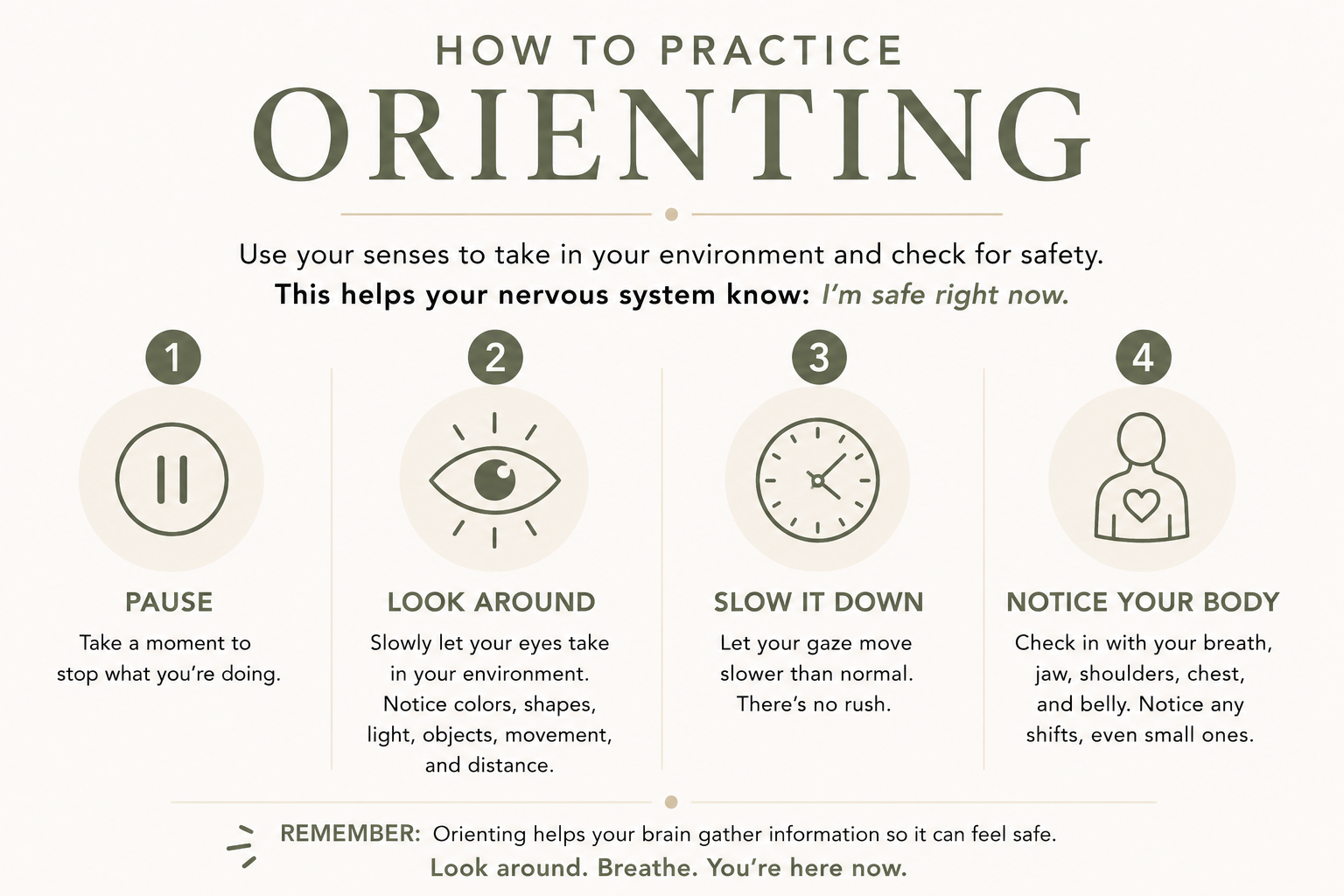
Orienting is meant to feel gentle, not forced.
You are not trying to “fix” yourself. You are simply allowing your nervous system to gather updated information from the environment.
Here’s a simple way to begin:
Step 1: Pause
Take a moment to stop moving or multitasking.
Step 2: Let Your Eyes Wander
Slowly look around the room or environment.
Notice:
- Colors
- Shapes
- Light
- Objects
- Movement
- Distance
Allow your eyes to land naturally on things that feel neutral or pleasant.
Step 3: Slow It Down
Most stressed nervous systems scan quickly.
Try letting your gaze move slower than normal.
Step 4: Notice Your Body
Without forcing anything, notice:
- Your breath
- Jaw tension
- Shoulders
- Chest
- Belly
Did anything soften, even slightly?
That is your nervous system responding.
Why Orienting Helps During Stress
When people are overwhelmed, anxious, overstimulated, or emotionally flooded, the brain often becomes internally focused and threat-oriented.
Orienting helps bring the nervous system back into relationship with the present environment.
This is why it can be helpful during:
- Anxiety
- Overwhelm
- Panic
- Emotional flooding
- Freeze states
- Transitions
- After conflict
- Before sleep
- During work breaks
It provides the brain with sensory evidence that the current moment may be safer than the nervous system initially predicted.
The Goal Is Not Perfection. It’s Safety.
One of the biggest misconceptions about healing is that nervous systems change through force.
But the brain learns safety through experience and repetition, not pressure.
Orienting is powerful because it works with the nervous system instead of against it.
It does not demand calm.
It invites awareness.
And for many people, that becomes the first step toward helping the body feel safe enough to soften.
If this idea of helping your body experience safety, not just think about it, resonates with you, I go much deeper into this inside my free masterclass, Heal Stubborn Pain With Your Brain.
I break down how the nervous system builds protective patterns, why stress can stay stuck in the body even when you logically “know better,” and how simple brain-based tools can begin helping your system shift out of survival mode.
If your body has felt tense, reactive, overstimulated, or constantly “on,” this is a great place to start.
Heal Stubborn Pain With Your Brain Masterclass
If you've done everything right and still feel stuck — this is why.
In Heal Stubborn Pain With Your Brain, I explain exactly what's happening in your brain and body when healing feels impossible — and give you two brain-based tools to start experiencing something different. Not more information to process. An actual shift, in your body, today.
What's inside:
- The real reason smart, self-aware people stay stuck the longest
- Why understanding your pain isn't enough — and what actually moves the needle
- 2 brain-based exercises that help your nervous system feel safe enough to finally let go