Get Your Nervous System on Your Side (And Why Calm Isn't the Goal)
Get Your Nervous System on Your Side (And Why Calm Isn't the Goal)
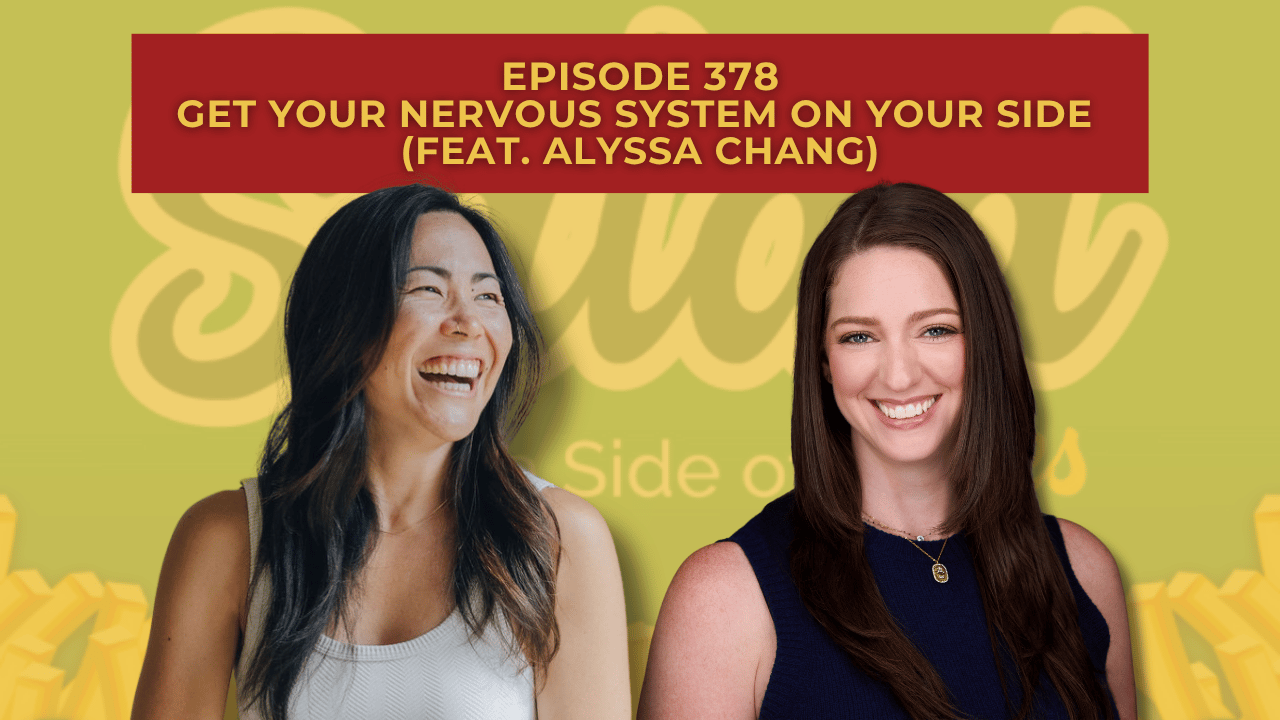
My conversation with Jenn Trepeck on the Salad With a Side of Fries podcast
Have you ever tried doing all the "right" things for your health, only to feel worse?
Maybe you've tried meditating to help your anxiety, but sitting quietly with your thoughts makes you feel even more anxious.
Or you've been told to take a deep breath when you're stressed, only to find yourself feeling lightheaded or like you can't get enough air.
Or maybe you're doing everything you're supposed to do. Eating well, exercising, getting enough sleep. And yet, you're still exhausted, tense, or dealing with symptoms that don't seem to make sense.
I've been there.
And it's one of the reasons I was so excited to join Jenn Trepeck on her podcast, Salad With a Side of Fries, for a conversation about something that's become quite the wellness buzzword lately: Nervous system regulation.
Because while I'm thrilled that more people are talking about the nervous system, I think we're missing some really important pieces of the conversation.
Like what regulation actually means. Why popular tools don't work for everyone. And why your body might be responding the way it does in the first place.
Here's a little of what we got into.
First, let's clear something up: Calm isn't the goal.
Somewhere along the way, nervous system regulation became synonymous with being calm, relaxed, and unbothered.
But that's not how your nervous system is designed to work.
Your nervous system's primary job is to help keep you alive. It's constantly gathering information from your body and environment, interpreting what's happening, and adjusting your responses accordingly.
Sometimes that means increasing your heart rate, sharpening your attention, or giving you the energy to respond to a challenge.
That's not necessarily dysregulation. That's your nervous system doing its job.
The problem isn't that we experience stress.
It's that sometimes we have a hard time shifting out of that stress response once the situation has passed.
So rather than trying to be calm 24/7, I want you to think about regulation as your ability to be adaptable, flexible, and resilient.
Can you respond to a stressful situation and eventually settle afterward?
Can you recognize when your body needs something different?
Can you move between different states instead of feeling stuck in one?
That's the work.
Your body isn't the enemy.
During the episode, Jenn brought up something I think so many people can relate to: feeling like your brain and body are fighting each other.
You know what you should be doing, but your body doesn't seem to cooperate.
I spent years feeling this way.
As a collegiate volleyball player and later a figure competitor, I was very good at pushing through discomfort.
No pain, no gain.
Rest was something you earned.
And if something wasn't working, the answer was usually to try harder.
Until my body started experiencing symptoms that didn't respond to any of my usual strategies.
I tried resting more. Changing my diet. Meditating. Following different health protocols.
But I wasn't getting better.
What eventually changed my approach was learning to look at my symptoms through the lens of my nervous system.
Instead of only asking, "How do I make this symptom go away?"
I started asking, "What might be contributing to this response?"
That shift changed how I understood my body.
And it's something I now help my clients explore, too.
To be clear, symptoms like chronic pain, fatigue, and anxiety can have many contributing factors and deserve appropriate medical evaluation. But understanding the nervous system's role can give us another useful piece of the puzzle.
Imagine your nervous system has a threat bucket.
One of my favorite ways to explain how stress accumulates is through something I call the threat bucket.
Imagine starting each day with a bucket.
Throughout the day, different experiences add to it.
Maybe you didn't sleep well.
You skipped breakfast.
You spent hours staring at a screen.
You had an uncomfortable conversation with someone.
You're worried about a deadline.
Individually, none of these things might feel like a big deal.
But together? They can add up.
And what's important to understand is that your bucket isn't going to look exactly like someone else's.
Our health histories, past experiences, sensory sensitivities, relationships, and environments all influence how we respond to stress.
When the demands on your system exceed your capacity to manage them, you may notice more tension, irritability, fatigue, anxiety, or other symptoms.
This is why understanding what fills your bucket can be so helpful.
Because regulation isn't just about what you do when you're already overwhelmed.
It's also about recognizing what's contributing to that overwhelm in the first place.
Why deep breathing doesn't work for everyone
This was one of my favorite parts of our conversation because I think it challenges a really common assumption.
We've all heard it:
Just take a deep breath.
And for some people, that's genuinely helpful.
But for others, certain breathing exercises can actually increase discomfort.
Here's why.
When you intentionally focus on your breathing, you're increasing your awareness of what's happening inside your body. This is called interoception.
For someone who experiences panic, breathlessness, or discomfort with bodily sensations, that increased awareness can sometimes feel overwhelming.
Certain breathing patterns can also lead to overbreathing, which lowers carbon dioxide levels and may contribute to dizziness, tingling, or feelings of breathlessness.
So if you've ever tried a breathing exercise and thought, "Why does everyone love this? I feel terrible!"
It doesn't necessarily mean you're doing it wrong.
It may mean that particular exercise, or the intensity of it, isn't a good fit for you right now.
This is why I teach people to assess, practice, and reassess.
Notice how you feel.
Try a small amount of a tool.
Then check in again.
Did something improve? Stay the same? Feel worse?
That information helps you make a more informed decision about what to try next.
And sometimes, less really is more.
We even tried a couple of brain-based drills.
One of the fun parts of this episode was getting Jenn to try a few exercises in real time.
We started with eye circles.
Before doing the drill, I had Jenn rotate her head from side to side and notice her range of motion and any tension.
Then we practiced moving her eyes through a circular pattern while keeping her head still.
When she reassessed her neck movement, she noticed she could rotate a little farther before feeling tension.
Pretty interesting, right?
We also experimented with a tongue mobility drill called Around the World.
These exercises gave us an opportunity to talk about how the brain integrates sensory and movement information, and why the same tool might produce different responses in different people.
A change after a drill doesn't necessarily tell us why it happened, but it gives us something to observe and explore.
And that's the bigger lesson.
You don't need to find the one magical nervous system exercise that fixes everything.
You need to get curious about how your system responds.
And don't underestimate the people around you.
We also talked about something I wish received more attention in conversations about regulation:
Co-regulation.
Have you ever noticed how being around certain people helps you feel more settled?
Maybe it's someone who listens without rushing to fix things.
Someone whose presence makes it easier to exhale.
Or even your dog, curled up beside you after a long day.
Our nervous systems are influenced by our relationships and social environments.
Jenn brought up a scene from Ted Lasso that beautifully illustrates this: one person sitting quietly beside another during an emotional moment, offering support without needing to say much.
I loved that example because regulation isn't always about doing another exercise.
Sometimes it's about connection.
And sometimes the most supportive thing we can do for our nervous system is spend time with people who allow us to feel comfortable being ourselves.
So where do you start?
If there's one thing I hope you take away from this conversation, it's this:
You don't need to become better at forcing your body to cooperate. You can become better at understanding how it responds.
Start small.
Notice when your shoulders creep toward your ears.
Pay attention to when you start rushing, holding your breath, or feeling more irritable than usual.
Get curious about what happened earlier in your day.
And when you experiment with a regulating practice, notice how your body responds rather than assuming it's supposed to work.
Your nervous system isn't meant to stay in one state forever.
It's designed to respond to life.
And the more you understand your own patterns, the more opportunities you have to support it.
Listen to the full conversation 🎧
There's so much more we covered, including why slowing down can feel uncomfortable for high achievers, how our past experiences shape our nervous system responses, and what it really means to build resilience.
A huge thank you to Jenn Trepeck for inviting me onto Salad With a Side of Fries and creating space for such a thoughtful, nuanced conversation.
If you've been curious about nervous system regulation, or you've tried all the "right" wellness tools and wondered why they don't seem to work for you, I think you'll really enjoy this one.
Episode 378: Get Your Nervous System on Your Side (feat. Alyssa Chang)
[Listen to the full podcast episode here]
And if something resonates, I'd love to hear what stood out to you!
Heal Stubborn Pain With Your Brain Masterclass
If you've done everything right and still feel stuck — this is why.
In Heal Stubborn Pain With Your Brain, I explain exactly what's happening in your brain and body when healing feels impossible — and give you two brain-based tools to start experiencing something different. Not more information to process. An actual shift, in your body, today.
What's inside:
- The real reason smart, self-aware people stay stuck the longest
- Why understanding your pain isn't enough — and what actually moves the needle
- 2 brain-based exercises that help your nervous system feel safe enough to finally let go